Most brands treat social issues like a live wire. They get close, they feel the heat, and they back away. Ben & Jerry's grabs it with both hands.
For decades, the Vermont ice cream company has been doing something that makes a lot of brand strategists deeply uncomfortable: taking clear, unambiguous stances on political and human rights issues. Not vague "we believe in kindness" statements. Actual positions. On actual issues. With actual stakes.
And they've built one of the most loyal brand communities in the world doing it.
The campaigns that made people uncomfortable — in the best way
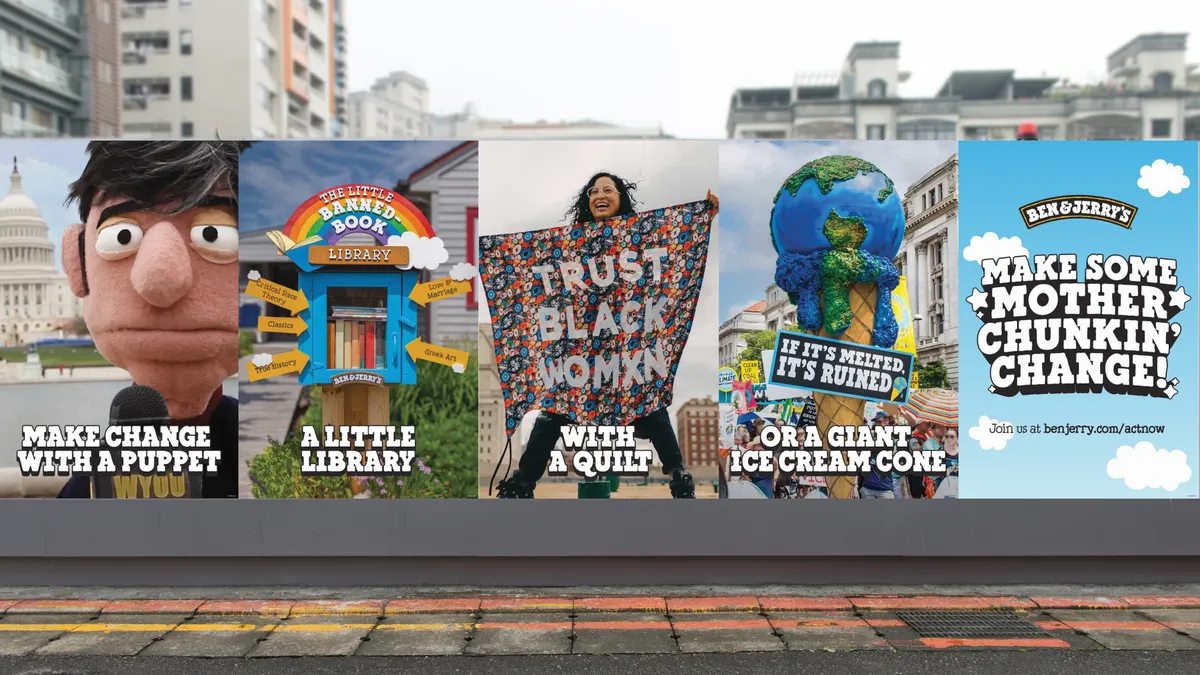
The billboard campaign you're looking at is a perfect example of how Ben & Jerry's operates. Each panel leads with an absurdist, disarming hook — "Change with a Puppet," "A Little Library," "With a Quilt" — and lands on a pointed call to action: "Or a Giant Ice Cream Cone." It's playful. It's weird. And underneath the whimsy is a completely serious message about civic engagement and showing up for your community.
That's the Ben & Jerry's formula. They use joy as a delivery mechanism for things that matter. They make it impossible to look away by making it fun to look at — and then they don't let you off the hook.
"Trust Black Women" isn't a tagline they put on a limited-edition pint and forgot about. It's connected to a documented, ongoing commitment to reproductive justice and racial equity. The brand has called out systemic racism by name. They've taken positions on refugee rights, LGBTQ+ equality, and campaign finance reform. They've done it clearly, consistently, and without walking it back when it got attention.
Why the design works
Ben & Jerry's campaigns succeed visually because they refuse to be serious in the way that most activist-adjacent brand content is serious. There are no stock images of sad people or inspirational sunsets. There's a puppet. There's a giant ice cream cone. There are bold, maximalist graphics with the energy of a protest sign and the production value of a prestige brand.
That contrast is doing a lot of work. It disarms you. It makes you stop scrolling. And once you're stopped, the message lands harder than it would have if they'd led with a somber headline and a donation link.
The lesson here is that mission-driven content doesn't have to be heavy to be serious. Joy is a legitimate creative strategy. Humor is a legitimate vehicle for values. Ben & Jerry's has known this for forty years.
What most brands get wrong about taking a stance
The brands that get in trouble with activism aren't usually the ones who go too far. They're the ones who go just far enough to signal virtue without actually committing to anything — and then get caught in the gap between what they said and what they did.
Ben & Jerry's works because the brand is built around the values, not the other way around. The activism isn't a campaign layer on top of an otherwise neutral brand. It's structural. It's in the governance of the company, the sourcing of the ingredients, the partnerships they keep and the ones they refuse.
When a brand has that kind of integrity all the way through, the campaigns aren't a risk. They're just proof.
The takeaway
If your brand fights for something, fight for it. Not carefully. Not with legal-approved hedging and a disclaimer in the footer. Fight for it the way Ben & Jerry's does — loudly, consistently, creatively, and without apologizing for having a point of view.
The brands that stand for something will always outlast the brands that stand for nothing. Ben & Jerry's has been proving that for decades, one pint — and one billboard — at a time.